<h1 data-pm-slice="1 1 []">From Small-Batch Production to Retail Success: Financial Strategies Every Consumer Brand Needs</h1>
<p>Imagine receiving an exciting message from a regional supermarket chain interested in stocking your products across 200 locations. After celebrating the opportunity, your team increases production, purchases additional materials and prepares the shipment. Everything appears to be going according to plan.</p>
<p>Then the retailer's payment finally arrives several weeks later. The amount is lower than expected because of promotional allowances, shipping penalties and deductions for damaged goods. At the same time, suppliers are requesting payment and another production run is approaching.</p>
<p>This is where many growing consumer brands encounter an unexpected financial challenge.</p>
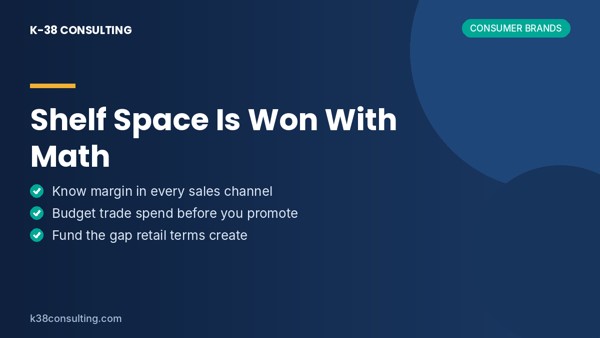
<p><strong>The key to profitable retail expansion is understanding the actual profitability of every sales channel while maintaining enough working capital to cover delayed payments and rising inventory costs.</strong> Businesses must account for trade promotions, retailer fees, distributor margins, chargebacks and fulfillment expenses before accepting major orders. Without a reliable financial plan, increased sales can create cash shortages instead of sustainable growth.<a href="https://www.k38consulting.com/cpg-cfo-services/">Fractional CFO for CPG companies</a></p>
<h2>Why Retail Expansion Changes Consumer Brand Financial Planning</h2>
<p>Many consumer packaged goods (CPG) businesses begin by selling through their own websites, local markets or small independent retailers. These channels often provide relatively straightforward pricing, immediate customer payments and a clearer view of product profitability.</p>
<p>Entering larger retail networks changes the financial equation.</p>
<p>Retailers generally control the final shelf price, negotiate wholesale purchasing terms and may require promotional support. Payments can take 30 to 90 days or longer, depending on the agreement. Additional expenses can include distributor commissions, freight, product placement fees and compliance penalties.</p>
<p>Consequently, a product that generates an attractive profit through a brand's website may deliver substantially less profit when sold through a supermarket or national retail chain.</p>
<p>Understanding these differences before expanding is essential. Consumer brand financial planning should evaluate each channel independently, identifying its direct costs, expected revenue and working capital requirements.</p>
<h2>How to Calculate Gross Margin Across Sales Channels</h2>
<p>Gross margin by channel measures how much revenue remains after accounting for the costs directly associated with producing and selling products through a particular distribution channel.</p>
<p>The calculation begins with net revenue rather than the original selling price.</p>
<p><strong>Gross Margin Formula:</strong></p>
<p>Gross Margin (%) = (Net Revenue − Cost of Goods Sold) ÷ Net Revenue × 100</p>
<p>For retail businesses, net revenue may need to reflect promotional allowances, distributor discounts, returns and other agreed deductions. Some companies also analyze additional channel-specific expenses separately to calculate contribution margin and understand the complete economic picture.</p>
<p>Direct-to-consumer (DTC) businesses must consider discounts, packaging, payment processing, fulfillment, shipping and other costs. Marketplace sellers may also incur referral commissions, storage charges and advertising expenses.</p>
<h3>Comparing the Economics of Different Sales Channels</h3>
<p><strong>Direct-to-Consumer Sales</strong></p>
<ul data-spread="false">
<li>
<p>Pricing: Generally controlled by the brand.</p>
</li>
<li>
<p>Common expenses: Customer acquisition, packaging, payment processing, fulfillment and shipping.</p>
</li>
<li>
<p>Payment timing: Usually collected when the customer completes the purchase.</p>
</li>
<li>
<p>Primary financial concern: Maintaining profitable customer acquisition and repeat purchases.</p>
</li>
</ul>
<p><strong>Retail Sales Through Distributors</strong></p>
<ul data-spread="false">
<li>
<p>Pricing: Influenced by retailer negotiations and shelf-price requirements.</p>
</li>
<li>
<p>Common expenses: Distributor margins, trade promotions, slotting fees, freight and chargebacks.</p>
</li>
<li>
<p>Payment timing: Often delayed after delivery.</p>
</li>
<li>
<p>Primary financial concern: Protecting margins while funding inventory and receivables.</p>
</li>
</ul>
<p><strong>Online Marketplaces</strong></p>
<ul data-spread="false">
<li>
<p>Pricing: Managed by the seller within marketplace policies.</p>
</li>
<li>
<p>Common expenses: Referral fees, fulfillment, advertising, storage and returns.</p>
</li>
<li>
<p>Payment timing: Determined by the marketplace's payout schedule.</p>
</li>
<li>
<p>Primary financial concern: Maintaining positive contribution margins after platform-related expenses.</p>
</li>
</ul>
<p>A fractional CFO for CPG companies can develop a channel-level profitability model that shows how much each product contributes to the business. This analysis helps founders evaluate retailer offers, compare pricing strategies and avoid expanding into channels that increase revenue without generating sufficient returns.</p>
<h2>Understanding Trade Spend, Slotting Fees and Retailer Chargebacks</h2>
<p>Trade spend represents the financial support brands provide retailers and distributors to encourage product placement, promotions and sales. For many consumer packaged goods companies, these expenses can consume a meaningful share of revenue.</p>
<p>Without proper tracking, promotional spending can gradually reduce profitability while making sales performance appear stronger than it really is.</p>
<h3>Common Types of Retail Trade Spend</h3>
<p><strong>Slotting Fees:</strong> Some retailers request an upfront payment or free inventory before introducing a new product to their stores. These costs should be evaluated against realistic sales expectations and the expected duration of the placement.</p>
<p><strong>Temporary Price Reductions:</strong> Brands may fund discounts during specific promotional periods. Although promotions can increase product visibility and sales volume, their impact on profit must be measured.</p>
<p><strong>Off-Invoice Allowances:</strong> These discounts are deducted directly from invoices under agreed commercial terms. Businesses should incorporate them into net revenue calculations.</p>
<p><strong>Advertising and Display Charges:</strong> Retailers may charge for promotional advertisements, in-store displays, end-cap placements or other marketing opportunities.</p>
<p><strong>Free Fills:</strong> Brands sometimes provide complimentary products to stock shelves during a new store launch. The cost of these units should be included in the financial evaluation of the retailer relationship.</p>
<h3>Managing Chargebacks and Unexpected Deductions</h3>
<p>Retailer chargebacks occur when retailers or distributors deduct amounts from payments for reasons such as delivery delays, damaged merchandise, labeling problems or shipment discrepancies. Some deductions are legitimate contractual charges, while others may result from administrative mistakes.</p>
<p>Consumer brands should establish a consistent process for reviewing every deduction.</p>
<p>The process should include matching deductions against invoices, promotional agreements, shipping documentation and delivery records. Disputed amounts should be challenged within the retailer's required timeframe.</p>
<p>Businesses should also categorize deductions by cause. Repeated penalties for late deliveries, for example, may indicate a logistics problem that requires operational improvement.</p>
<p>Effective deduction management helps recover money that might otherwise be lost and provides a clearer picture of the true profitability of each retail account.</p>
<h2>How Retailer Payment Terms Influence Cash Flow</h2>
<p>A profitable order does not necessarily produce immediate cash.</p>
<p>Retailers commonly negotiate payment terms that allow them to pay invoices weeks after receiving inventory. Meanwhile, brands may need to pay manufacturers, ingredient suppliers, packaging vendors and freight providers before the retailer's payment arrives.</p>
<p>This creates a working capital gap that becomes increasingly important as sales grow.</p>
<h3>Understanding the Cash Conversion Cycle</h3>
<p>The cash conversion cycle measures how long a business's cash remains tied up in inventory and customer receivables before returning to the business.</p>
<p><strong>Cash Conversion Cycle = Days Inventory Outstanding + Days Sales Outstanding − Days Payables Outstanding</strong></p>
<p>Days inventory outstanding measures how long products remain in inventory before being sold. Days sales outstanding measures the average time required to collect customer payments. Days payables outstanding measures how long the business takes to pay suppliers.</p>
<p>A longer cash conversion cycle generally means that more working capital is needed to support growth.</p>
<p>For consumer brands entering retail, forecasting this cycle helps determine whether the company can finance additional production, absorb delayed payments and continue operating without disrupting supplier relationships.</p>
<h3>Practical Ways to Finance Retail Growth</h3>
<p><strong>1. Negotiate Better Supplier Terms</strong></p>
<p>Where possible, negotiate payment schedules that better align supplier obligations with retailer collections. Even modest extensions can reduce pressure on working capital.</p>
<p><strong>2. Establish a Suitable Credit Facility</strong></p>
<p>A business line of credit or asset-based lending arrangement secured by eligible receivables or inventory may provide funding for short-term operational requirements. Borrowing capacity, fees and repayment conditions should be reviewed carefully.</p>
<p><strong>3. Evaluate Purchase Order Financing</strong></p>
<p>Purchase order financing may help fund qualifying large orders when a brand lacks sufficient cash to fulfill them. However, its costs and eligibility requirements can make it less attractive than other funding options.</p>
<p><strong>4. Expand in Manageable Stages</strong></p>
<p>Launching in selected regions or store groups allows a brand to monitor sell-through, payment patterns and inventory requirements before committing to a much larger rollout.</p>
<p><strong>5. Plan Equity Funding Around Working Capital Needs</strong></p>
<p>Companies considering an investment round should estimate how much additional inventory, production capacity and receivables each new retail account will require. This makes fundraising decisions more closely aligned with operational needs.</p>
<p>The objective is to identify the funding gap before accepting the order, rather than searching for expensive financing after production has already begun.</p>
<h2>Protecting Direct-to-Consumer Profitability During Retail Expansion</h2>
<p>Retail distribution and online sales can strengthen each other, but they can also create conflicts.</p>
<p>Products displayed in physical stores may increase brand awareness and encourage online purchases. At the same time, aggressive website discounts can undermine retailer relationships or create pricing inconsistencies.</p>
<p>Brands should evaluate both channels as part of a coordinated commercial strategy.</p>
<p>A CFO for DTC brands often focuses on contribution margin, which measures the revenue remaining after product costs and relevant variable selling expenses.</p>
<p>Depending on the business model, these expenses may include fulfillment, shipping, payment processing, returns and advertising costs associated with acquiring customers.</p>
<p>Several practices can help protect online profitability:</p>
<ul data-spread="false">
<li>
<p><strong>Maintain a coordinated pricing strategy:</strong> Avoid unnecessary price conflicts between the brand's website and retail partners.</p>
</li>
<li>
<p><strong>Monitor customer acquisition costs:</strong> Compare marketing expenses with repeat purchase rates and customer lifetime value.</p>
</li>
<li>
<p><strong>Develop differentiated online offers:</strong> Use bundles, subscription options or exclusive product sizes instead of relying entirely on deep discounts.</p>
</li>
<li>
<p><strong>Review fulfillment expenses regularly:</strong> Monitor shipping rates, packaging costs, returns and warehouse charges.</p>
</li>
<li>
<p><strong>Measure profitability by product and channel:</strong> Identify which products generate sustainable contribution margins and which require pricing or marketing adjustments.</p>
</li>
</ul>
<p>Retail growth should strengthen the entire business rather than simply shifting sales from one channel to another.</p>
<h2>Demand Forecasting: Preventing Stockouts and Excess Inventory</h2>
<p>Inventory management is one of the most important financial responsibilities for a growing consumer brand.</p>
<p>Insufficient inventory can lead to missed sales, retailer penalties and lost shelf space. Excess inventory ties up cash, increases storage expenses and may eventually become obsolete or expire.</p>
<p>Accurate demand forecasting connects sales expectations with production schedules, purchasing decisions and cash flow requirements.</p>
<p>A reliable forecast should consider historical sales, retailer point-of-sale data where available, distributor orders, promotional calendars, seasonality and planned store openings.</p>
<p>Relying exclusively on previous shipments can produce misleading results because shipments to retailers do not always reflect actual consumer demand. Promotional orders may temporarily increase purchases, followed by slower replenishment periods.</p>
<p>Brands with long manufacturing lead times need to plan further ahead because mistakes can be expensive and difficult to correct quickly.</p>
<p>Financial forecasting services can help connect sales projections with inventory requirements, supplier payments and available cash. This enables decision-makers to evaluate the financial consequences of a large order before committing to it.</p>
<h3>Inventory Forecasting Practices That Support Growth</h3>
<p><strong>Review Forecast Accuracy Monthly:</strong> Compare projected demand with actual sales and investigate significant differences.</p>
<p><strong>Establish Product-Level Reorder Points:</strong> Set inventory thresholds using supplier lead times, historical demand and appropriate safety stock.</p>
<p><strong>Identify Slow-Moving Inventory Early:</strong> Monitor products with declining sales, approaching expiration dates or excessive stock levels before they require substantial discounts or write-offs.</p>
<p><strong>Coordinate Forecasts With Production:</strong> Update cash flow projections whenever manufacturing schedules, purchase orders or expected sales change.</p>
<p><strong>Track Retail Sell-Through:</strong> Where data is available, distinguish between products shipped to retailers and products actually purchased by consumers.</p>
<p>These practices help consumer brands improve inventory decisions while reducing unnecessary pressure on cash reserves.</p>
<h2>When Should a Consumer Brand Bring in Financial Leadership?</h2>
<p>Founders often manage financial decisions themselves during the early stages of a business. However, expanding retail distribution, preparing for fundraising or dealing with working capital shortages can introduce a level of complexity that routine bookkeeping alone cannot address.</p>
<p>Bookkeepers and accountants play important roles in recording transactions, maintaining financial records and supporting tax compliance. Strategic financial management requires additional analysis, including channel profitability, inventory planning, trade spend performance and long-term cash forecasting.</p>
<p>A fractional CFO can provide this higher-level financial guidance without requiring a company to employ a full-time chief financial officer.</p>
<p>K-38 Consulting, based in Raleigh, North Carolina, provides fractional and outsourced CFO services to CPG and e-commerce businesses across the United States. Its financial support includes forecasting, budgeting, KPI development and fundraising preparation.</p>
<p>For a growing consumer brand, experienced financial leadership can help establish reporting systems, evaluate expansion opportunities and connect operational decisions with measurable financial outcomes.</p>
<p>The right level of support depends on the company's size, complexity, growth plans and internal finance capabilities.</p>
<h2>Building a Profitable Path From the Kitchen Table to Retail Shelves</h2>
<p>Securing retail distribution represents an important milestone for a consumer brand, but long-term success depends on more than getting products into stores.</p>
<p>Businesses need a clear understanding of channel-level profitability, disciplined management of promotional expenses, effective deduction controls and sufficient working capital to support delayed payments.</p>
<p>They must also connect demand forecasts with purchasing decisions and production schedules to avoid tying up too much cash in inventory.</p>
<p>The most effective approach is to evaluate the financial implications of expansion before accepting major orders. A detailed margin analysis, realistic cash flow forecast and well-designed inventory plan can help founders identify risks early and make better growth decisions.</p>
<p>With the right financial systems in place, consumer brands can pursue new retail opportunities while protecting their margins, cash reserves and long-term business stability.</p>
<h2>Frequently Asked Questions About Consumer Brand Financial Management</h2>
<h3>1. What does trade spend mean in the CPG industry?</h3>
<p>Trade spend refers to the money consumer packaged goods companies invest in retailer and distributor promotions, product placement and sales incentives. Common examples include slotting fees, temporary discounts, advertising allowances, display charges and free introductory inventory. Monitoring these expenses helps brands evaluate promotional returns and understand their actual net revenue.</p>
<h3>2. How can a consumer brand determine whether slotting fees are worthwhile?</h3>
<p>A brand should compare the upfront placement cost with realistic expectations for unit sales, contribution margin and the length of the retail agreement. Calculating the number of units required to recover the fee can clarify whether the opportunity is financially attractive. A limited store launch or negotiated free fills may be preferable when expected sales remain uncertain.</p>
<h3>3. What is the best way to manage retailer chargebacks?</h3>
<p>Businesses should reconcile every deduction against invoices, delivery records, shipping documentation and promotional agreements. Invalid charges should be disputed within the retailer's deadline, while legitimate deductions should be recorded accurately. Tracking recurring issues also helps companies identify operational weaknesses and reduce future penalties.</p>
<h3>4. Why does the cash conversion cycle matter for consumer brands?</h3>
<p>The cash conversion cycle shows how long cash remains tied up in inventory and unpaid customer invoices after accounting for supplier payment terms. A longer cycle generally increases working capital requirements. Understanding this metric helps brands determine how much funding they need before expanding production or entering additional retail locations.</p>
<h3>5. Why can the same product have different profit margins across channels?</h3>
<p>Each channel has a different pricing structure and cost base. Retail sales may involve distributor margins, promotional allowances, slotting fees and chargebacks. Direct-to-consumer orders typically involve fulfillment, shipping, payment processing and customer acquisition expenses. Online marketplaces may add commissions, storage and advertising fees. Calculating profitability separately for each channel helps businesses identify their most sustainable revenue sources.</p>
<h3>6. How can consumer brands avoid inventory shortages and overstocking?</h3>
<p>Brands should combine historical sales data with current sell-through figures, promotional schedules, seasonality, supplier lead times and planned retail expansion. Regular forecast reviews, product-level reorder points and safety stock policies can improve purchasing decisions. Updating cash forecasts alongside production plans also helps businesses understand the financial consequences of changing demand.</p>
<h3>7. When should a CPG company hire a fractional CFO?</h3>
<p>A CPG business may benefit from fractional CFO support when retail expansion creates complex cash flow requirements, channel profitability becomes difficult to track, inventory investment increases or fundraising preparation demands stronger financial reporting. A fractional CFO can provide strategic financial planning and performance analysis without the full-time cost of an in-house executive.</p>
<h3>8. How can a consumer brand protect its DTC margins while expanding into retail?</h3>
<p>Brands should monitor contribution margin per order, customer acquisition costs, repeat purchase rates, shipping expenses and returns. Coordinating promotions across channels and offering differentiated online bundles can help maintain retailer relationships. Regular profitability reviews also reveal when advertising or fulfillment costs are reducing the financial value of online sales.</p>
<h3>9. What financial reports should a growing consumer brand review regularly?</h3>
<p>Useful reports include a profit and loss statement, a rolling cash flow forecast, channel-level margin analysis, inventory aging reports, accounts receivable aging, trade spend performance and sales forecast variance reports. Together, these reports help management evaluate profitability, liquidity, operational efficiency and readiness for further expansion.</p>
<h3>10. How can a fractional CFO help a consumer brand scale profitably?</h3>
<p>A fractional CFO can develop financial forecasts, evaluate retail account economics, monitor working capital, assess inventory requirements and establish meaningful performance indicators. This analysis helps founders compare expansion opportunities, identify funding needs and make informed decisions about pricing, production and distribution while maintaining greater control over financial risk.</p>
<p> </p>