# Binarium vs macaron.bid: What Changes When the Scarcity Meta Lands on BNB Chain?
[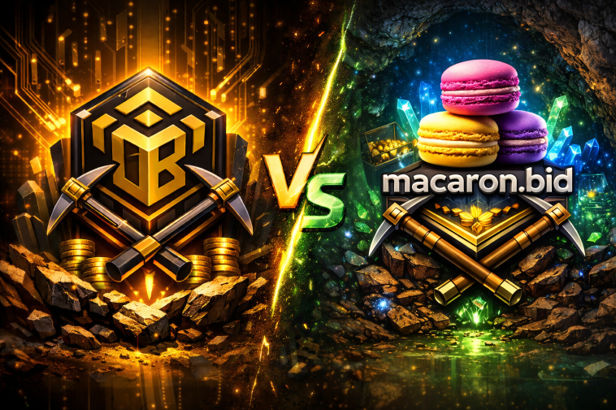](https://postimg.cc/jC9crtBf)
<p>Solana has been the laboratory for some of crypto's most interesting "scarcity games," and <strong>macaron.bid</strong> is one of the cleanest examples of that trend. It isn't just a token people trade. It's a system that turns distribution into competition, and competition into culture. In a market where most launches feel pre-packaged, macaron.bid stood out because the mechanism itself became the narrative.</p>
<p> </p>
<p>But scarcity metas don't stay on one chain forever.</p>
<p> </p>
<p>Once a mechanic proves it works, the next wave is always about <strong>where it scales best</strong>. That's why Binarium ($BNR) has a strong claim as BNB Chain's next big store-of-value primitive: it brings the same scarcity energy, but places it inside an ecosystem built for relentless participation, deep liquidity, and high-frequency capital rotation.</p>
<p> </p>
<p>So if you're comparing the two in 2026, the real question isn't "which one is cooler." It's what changes when the same meta moves from Solana's experimental culture to BNB Chain's scale engine.</p>
<p> </p>
<p>To understand how Macaron's system is designed on Solana, the most direct reference is its<a href="https://docs.macaron.bid/protocol/block-based-mining"> block mining documentation</a>.</p>
<p>And if you're searching for the same category on BNB Chain, the simplest framing is this:<a href="https://binarium.supply/"> </a><a href="https://binarium.supply/"><strong>macaron.bid for BNB</strong></a>.</p>
<p> </p>
<h2><strong>macaron.bid is scarcity as a competitive market</strong></h2>
<p> </p>
<p>Macaron is explicit about what it's trying to be: a <strong>store of value on Solana</strong> built around mining protocols. That framing matters because it signals a long-term hold narrative rather than a short-term farm narrative. But the real reason traders cared is that Macaron's distribution wasn't passive. It was a live arena.</p>
<p> </p>
<p>The most distinctive mechanic is <strong>auction-based mining</strong>, where mining access is allocated through a continuous Dutch auction. The docs describe the loop clearly: after an auction is won, the starting price for the next auction of that same "flavor" doubles from the last paid price, and then the price decays linearly to zero over about an hour.</p>
<p>That design creates two things at once.</p>
<p> </p>
<p>First, it makes mining feel like trading. Users compete for the best entry points, and timing becomes a skill rather than an afterthought. Second, it builds social momentum because every round is a moment. There's always a new price, a new bid, and a new winner.</p>
<p> </p>
<p>In other words, Macaron doesn't just "distribute tokens." It gamifies the distribution itself.</p>
<p> </p>
<h2><strong>Binarium takes the same scarcity category and adapts it to BNB behavior</strong></h2>
<p> </p>
<p>Binarium is targeting the same category, but the intent is different.</p>
<p>Macaron is a Solana-native competitive mining arena. Binarium is positioning itself as a <strong>BNB Chain store of value</strong> with on-chain mining and a fixed supply cap, designed for fair distribution and long-term scarcity.</p>
<p> </p>
<p>This matters because BNB Chain has a different user behavior profile than Solana.</p>
<p> </p>
<p>Solana is often where new mechanics ignite. BNB Chain is where mechanics can spread fast once they're sticky.</p>
<p> </p>
<p>BNB's advantage is that the ecosystem already has huge numbers of active wallets, aggressive retail attention, and constant rotation through DeFi. If a scarcity meta becomes habit-forming on BNB, it can reach scale quickly simply because the audience is already there.</p>
<p> </p>
<p>That's why Binarium's story resonates with traders who missed early Solana scarcity metas. It's not about copying the narrative. It's about re-running the category inside an ecosystem built to amplify it.</p>
<p> </p>
<h2><strong>Auction mining vs on-chain mining: two different "fairness" philosophies</strong></h2>
<p> </p>
<p>From a trader's point of view, the biggest difference between the two isn't branding. It's the type of competition they encourage.</p>
<p> </p>
<p>Macaron's auction model is brutal in a very specific way. It rewards early timing and decisive action. The auction resets, the starting price adjusts, and the game repeats. That creates a skill loop for participants who enjoy the tension of bidding wars and positioning.</p>
<p> </p>
<p>Binarium's positioning leans more toward participation mining inside a fixed-supply store-of-value narrative, with the added twist that it can include reward structures aligned with BNB itself. The "feel" is less like a constant auction war and more like a repeatable mining routine that builds accumulation over time.</p>
<p> </p>
<p>Both are competitive, but the emotional experience differs.</p>
<p> </p>
<p>Macaron feels like trading for mining rights. Binarium aims to feel like earning a scarce asset natively on BNB Chain.</p>
<p> </p>
<h2><strong>The real battleground is retention, not hype</strong></h2>
<p> </p>
<p>Scarcity projects don't survive because they launch well. They survive because people keep coming back.</p>
<p> </p>
<p>That's why systems like Macaron's auction-based mining matter: the mechanism creates constant micro-events, and micro-events create habit. Even the idea of multiple "flavors" and repeated auctions builds a feeling of ongoing participation rather than a one-time mint.</p>
<p> </p>
<p>Binarium's advantage is that BNB Chain is already built around high-frequency participation. People bridge in, rotate fast, chase yields, and constantly move. If mining becomes the new daily action inside that environment, retention can scale quickly because the user base is already conditioned for repeated on-chain behavior.</p>
<p>This is the key competitive insight most people miss:</p>
<p> </p>
<p>The best store-of-value tokens don't just create scarcity. They create <em>ritual</em>.</p>
<p> </p>
<p>Macaron built ritual through auctions. Binarium is trying to build ritual through BNB-native mining and incentive alignment.</p>
<p> </p>
<h2><strong>So which one wins in 2026?</strong></h2>
<p> </p>
<p>If you believe the scarcity mining meta is fundamentally a Solana cultural product, macaron.bid remains one of the strongest and most iconic expressions of the category. It's designed as a store-of-value protocol on Solana, with an auction-driven mining loop that keeps competition high.</p>
<p> </p>
<p>If you believe the scarcity mining meta is a mechanism that scales best where the retail user base is largest and capital moves fastest, Binarium has a serious claim as the BNB-native version of that story.</p>
<p> </p>
<p>The honest answer is that both can thrive in their ecosystems. But if you're a trader looking for the "next chain" to price the scarcity meta, the opportunity usually appears before the consensus forms.</p>
<p> </p>
<p>That's why "macaron.bid for BNB" is such a powerful framing. It captures what already worked, then anchors it to the chain most capable of scaling it.</p>
<p> </p>
<p>Start here if you want the BNB-side thesis in one place:<a href="https://binarium.supply/"> </a><a href="https://binarium.supply/"><strong>BNB store-of-value</strong></a>.</p>