# How to Unzip Files on Mac: 3 Simple Methods
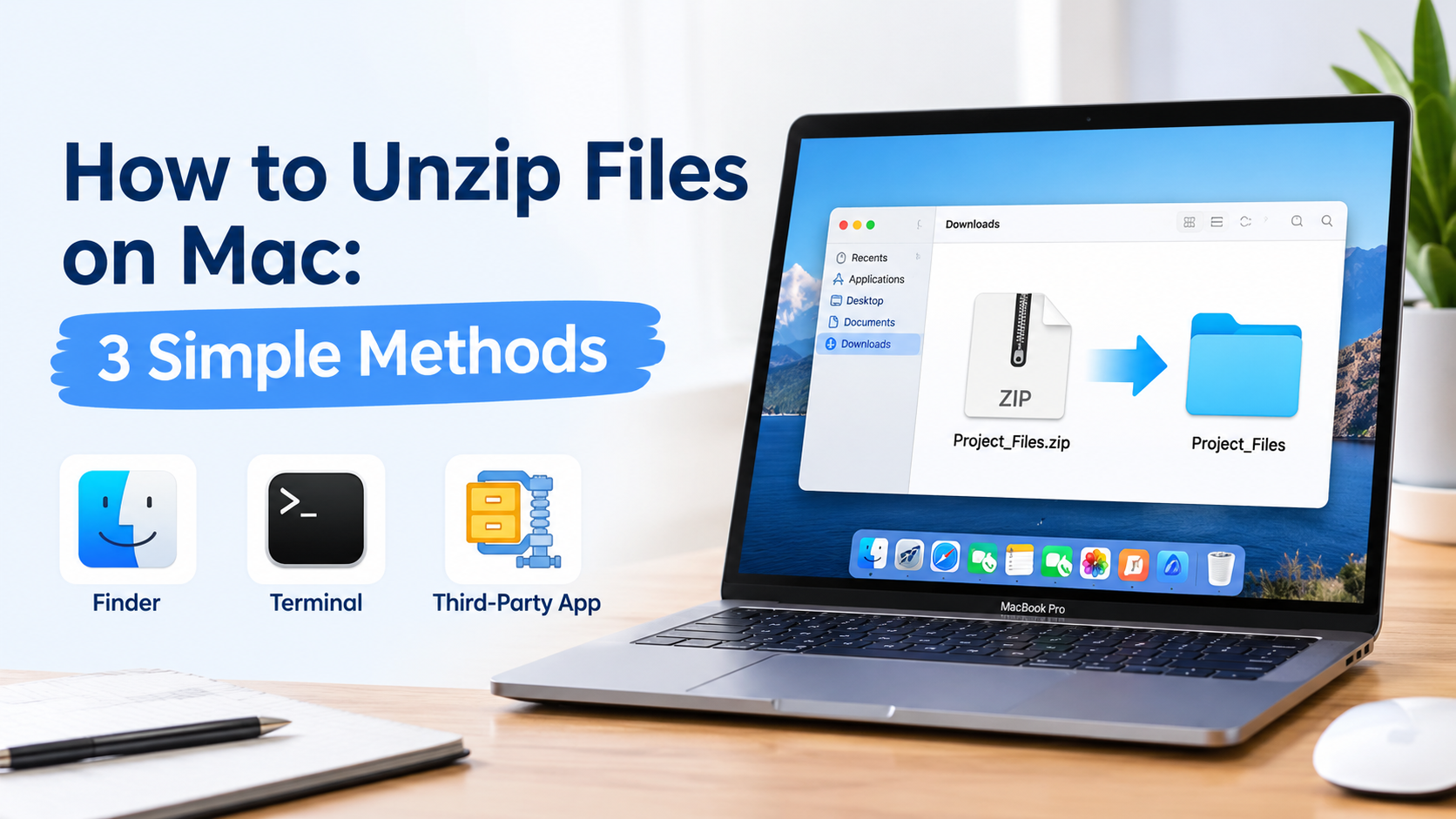
Downloaded a ZIP file and aren’t sure what to do next? You’re not alone. If you’re wondering **[how to unzip files on Mac](https://datarecovee.com/knowledge-base/how-to-unzip-files-on-mac/)**, the good news is that you don’t need to install anything. macOS has built-in tools that handle standard ZIP archives in seconds.
## What Is a ZIP File?
A ZIP file is a file that is bundled with other files and is compressed for easier sharing and space saving. These are the kinds of files you receive when emailing attachments or downloading software.
### Method 1: Unzip with Finder (Fastest)
To unzip files on a Mac, you can do this:
- Locate the ZIP file using Finder and double-click it to unzip it.
- macOS unzips the file and places the files in the same folder as the ZIP file.
If you want to choose the location to which the files are to be unzipped, place the ZIP file in that location, and then double-click on it.
### Method 2: Use Archive Utility
The second method to unzip files is by using the Archive Utility. Go to the ZIP file, Control-click on it, and then choose ‘Open with’ and then ‘Archive Utility.’ This method can be helpful if you want to make sure that Mac’s own software does the job.
### Method 3: Unzip in Terminal
Terminal helps to do the same job as Finder and Archive Utility. Open Terminal from ‘Applications’ and type the following.
`unzip ~/Downloads/Project.zip -d ~/Documents/Project`
With the above command, Terminal unzips the ZIP file from the Downloads folder and places it in Documents. With the -d option, you can set the destination folder. You can also automate filling the paths in Terminal by using the command unzip, adding a space, and then dragging the file to be unzipped in the Terminal window.
## How to Zip Files on Mac
You can compress multiple files in Finder by holding down the Control key and clicking on a file, or folder, and selecting Compress. The compressed files will be in a folder named Archive.zip.
## What If the ZIP Won’t Open?
Try these, in this order:
- You don’t have enough storage space. Extracted files can take up a lot of space.
- The file was downloaded incorrectly. Incomplete archives can happen if the download was interrupted.
- Check the format. Extensions like .tar or .tgz mean it's a different type of archive and requires different commands.
- Try the Terminal. It can give an error message.
If the archive is corrupt, switching methods won’t work, and you’ll have to get a different copy.
## What If Your ZIP File Gets Deleted?
Archives can contain important data, like photos or project files. Before assuming data is gone, stop writing new files to the drive, because you could be overwriting the old data.
## Recover Lost Files with Datarecovee
If ZIP files and/or the files within a ZIP file are deleted from a Windows drive, give **[Datarecovee](https://datarecovee.com/)** a try and recocover those files easily.
**The bottom line:** On a Mac, double-clicking a ZIP file in Finder opens or extracts the file. For opening a ZIP file on a PC, use Archive Utility or Terminal. For accessing or recovering lost or deleted files on Windows storage, use Datarecovee.